Pellet Additive Manufacturing — Large-Scale Industrial 3D Printing Technology
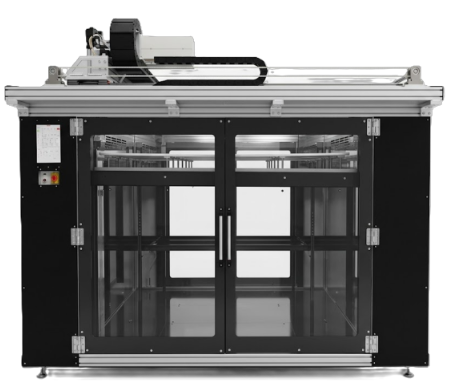
Limitations of Conventional FFF
Advantages of PAM
| Category | FFF | PAM |
|---|---|---|
| Material Form | Filament (Ø1.75 / 2.85mm) | Industrial Pellets |
| Material Cost | High (6× with processing) | Low (raw material, direct) |
| Max Build Size | Under 600 mm | Over 2,000 mm |
| Extrusion Rate | < 0.1 kg/h | Up to 10 kg/h |
| Material Variety | Limited | PEEK · ULTEM · CF composites |
PAM Working Principle — Pellet Additive Manufacturing
Dried at 90–120°C for 2 h per material, then auto-fed to hopper via compressor
Single-screw extruder (max 450°C) melts and plasticizes pellets for precise discharge
Large nozzle (5–10mm) deposits precise layers; Teflon ring compresses inter-layer voids
After cooling, CNC finishing or surface treatment secures final part quality
1/6
Material Cost
Pellet vs. FFF filament cost
10kg/h
Extrusion Rate
Year 6 extruder spec
2,000mm
Max Build Length
2,000×1,500×1,000mm build
300°C
Max Extrusion Temp
Super engineering resin support
We welcome joint research and partnership proposals related to PAM technology.
Contact Us